I was eating some sauerkraut with my dinner last week. It’s part of my bacteria quest that I wrote about a little while ago. I was sitting there thinking to myself,
“Boy, this is great. I’m eating this food to help out my good bacteria population and maybe help heal my gut and who knows what else!”
Then an image popped into my head, of my grandmother canning up her soup in mason jars from years ago. I remember it taking heat to cause those lids to pop down and seal.
Hmmm….. heat kills bacteria 🤔. This store bought organic sauerkraut is from a sealed jar. Is there any other ways of sealing a jar other than from heat?
Probably not?
A quick internet search about sauerkraut and the sealing process. Son of a gun! Most store sold sauerkraut is pasteurized and thus killing off all the bacteria! Grrrrr….. I’ve been eating all this pickled cabbage without getting the benefit of the bacteria! The things you don’t know about until you do a little digging (or thinking).
Everyone is constantly scared about bacteria!
Fortunately, making sauerkraut is not very hard to do. I received a little birthday money as a gift and bought some sauerkraut making mason jar lids (stainless steel, I hate plastic, I avoid it as much as possible). I started channeling my inner Ukrainian.
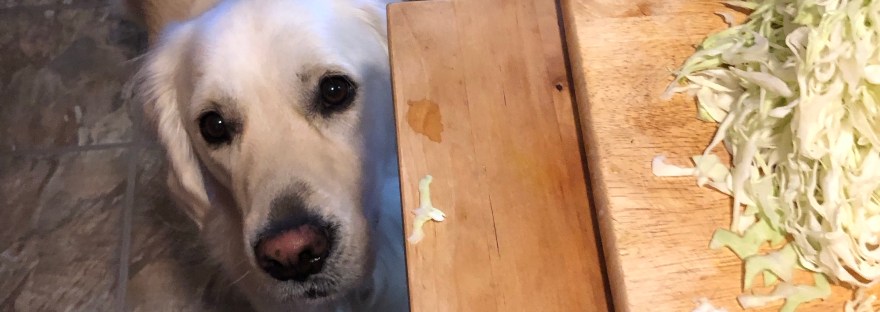
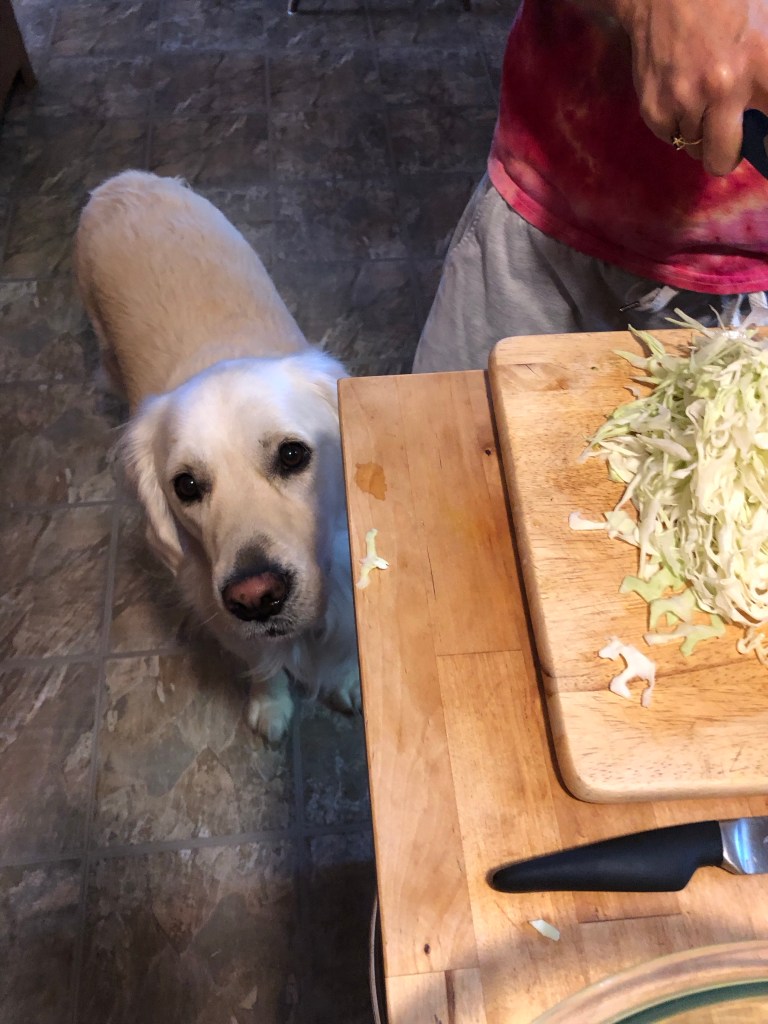
Yukon loves cabbage! He was quite excited about the process and quickly gobbled up any cabbage spills.
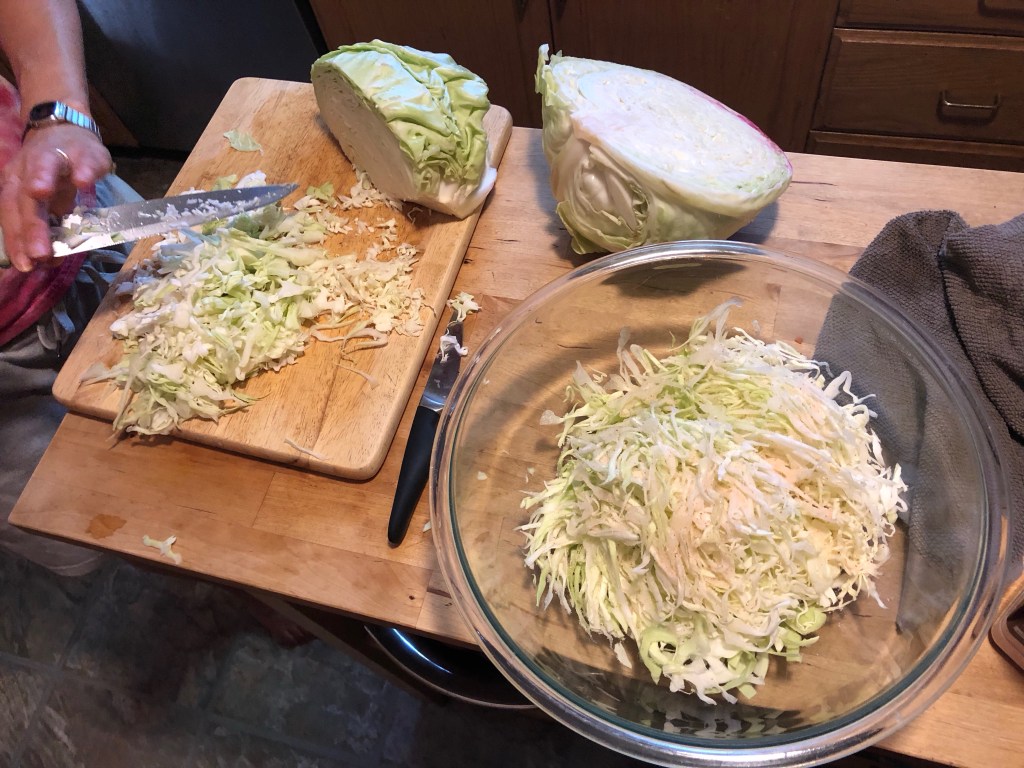
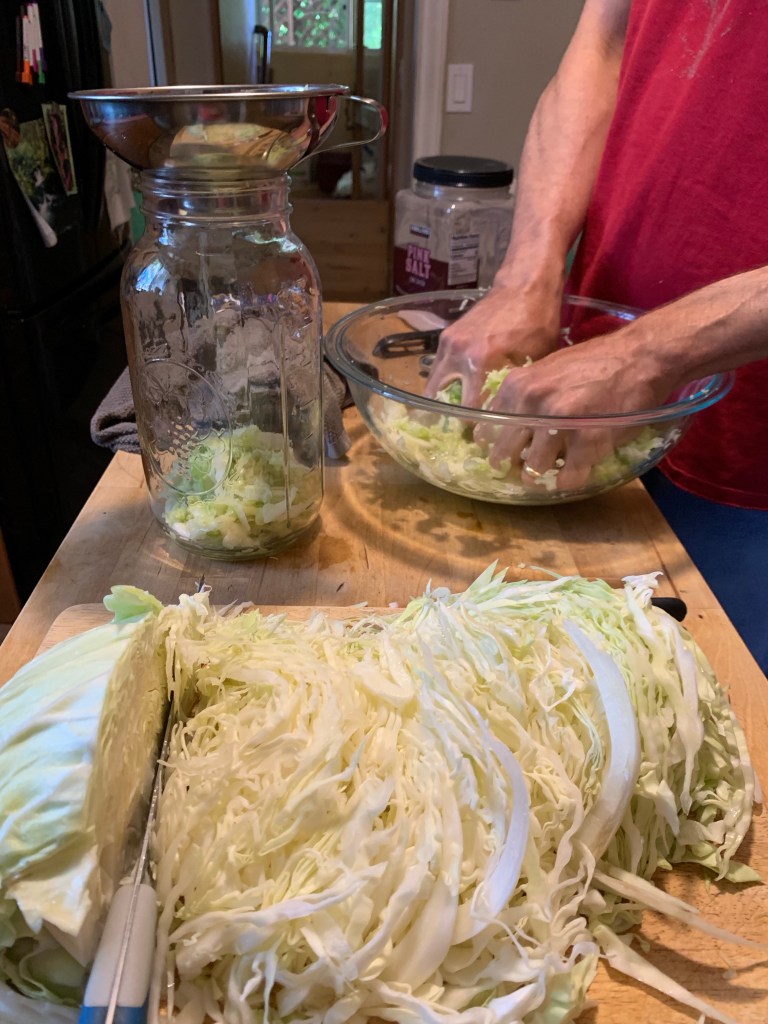
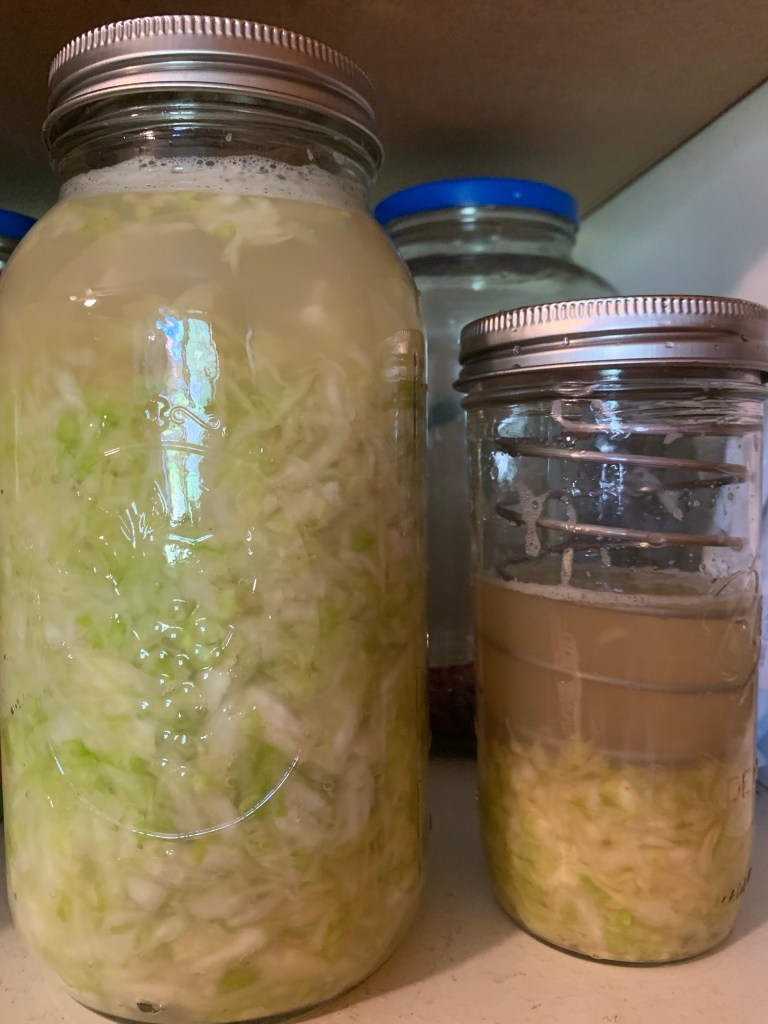
You just have to chop up the cabbage. Add a tablespoon of salt per 2 pounds of cabbage. Massage it in a bowl until it’s soft, and the juices are released. Put it all in a jar, with all the cabbage under the fluid (our kit has a spring to hold it down), and in a month, you have fresh sauerkraut full of good BACTERIA!
The only problem is I have to wait a month for it to be ready. But I suppose, if that’s one of my complaints, I’m doing alright.
I had a birthday recently, which of course got me thinking about birthdays. I couldn’t help chuckling to myself about how birthdays have different meanings depending on the age.
Age 0-2 – I have no idea what’s going on, but look at all these people.
Age 3-9 – Presents! Cake!
Age 10 – Double digits, fist pump.
Age 11-12 – Presents! Cake!
Age 13 – I’m a teenager, chest puffed up.
Age 14 -19 – I’m really cool, but secretly Presents! Cake!
Age 20 – Twenty!
Age 21-39 – Lets party!
Age 40 – Forty?! Crisis time?
Age 41-55 – My body doesn’t work as well as my mind thinks it should, and what’s that wrinkle?
Age 56-65 – I’m starting to look old.
Age 66-75 – I’m passed the speed limit!
Age 76-79 – I’m starting to feel old.
Age 80-89 – How did I get so wise?
Age 90-99 – I have no idea what’s going on, but look at all these people.
Age 100 – Score! I reached level 100!
Any age- If you have cancer, I made it another year!
It’s something that I think of quite frequently these days. I’m mean, doctors have seen some horrific things due to bacteria, so a bunch of it is very justified. But I feel bacteria is not fully understood, and medicine just takes the approach that they normally do, and nuke the heck out of it.
I’ve thought vaguely about bacteria for a while, but I really started contemplating about it at the beginning of the year. My dog Yukon had a medical procedure, and they put him on antibiotics afterward. As I mentioned in a few other posts, I had been working with the garden soil, which involved a lot of manure.
Yukon does not eat manure, as some dogs do. I was spreading it around on the ornamental plants in the front yard, where he spends a lot of his time. He had been taking antibiotics for about 7 days. All of a sudden, he started chowing down on the manure.
“That’s weird” I said to my wife.
I started thinking about, when he was a puppy, he had an infection and the vet put him on antibiotics. He snacked on some manure while we would go hiking, that time as well. Those are the only times he has eaten manure. He ignores it the rest of the time. And believe me, I still spread it around a lot.
What are his animal instincts telling him?
I have a few cancer theories, and gut bacteria being one of them. Cancer develops from a dysfunctional immune system. Everyone has cancer cells, but most people’s immune systems wipe it out. Your immune system comes from your gut. Wouldn’t it be logical that people who have cancer (or other health problems) have a significant problem with their gut?
Our gut should be like healthy garden soil. Full of life and diversity. I do believe that most intestinal troubles, weird unexplained rashes, chronic inflammation and maybe autoimmune diseases are all from your gut being out of wack.
I know I personally was exposed to way too many antibiotics, as well as a lot of other environmental toxins. I felt like any time I went to the doctor with any sickness, I was prescribed antibiotics. “It’s most likely a virus, but take these antibiotics just in case.” It took me too long to stop and think about the side consequences of taking so many.
I also find it curious, that veterinarians seem to be very pro probiotics, especially after a course of antibiotics, and will even prescribe probiotics for an animal.
Try to ask a human doctor, especially an oncologist about probiotics, and in my experience, they put on their politician face and dodge the question or try and pass the buck. It’s very frustrating.
To be fair, there are some doctors who are currently studying gut bacteria and the system on a whole. It also seems like the studies are picking up steam. There are even some studies from hundreds of years old. Ever hear of yellow soup from ancient Chinese medicine? It’s worth a google search and read, if you aren’t squeamish (dogs are definitely not squeamish about it).
I came across a study earlier in the year, unfortunately I can’t find it anymore. It was talking about the relationship of a healthier gut micro biome and people achieving MRD negative status from a stem cell transplant. People who had a better gut were more likely to be MRD negative. After reading that, I started eating probiotics foods prior to my transplant and started eating them again as soon as it was safe for me to do so afterwards.
While trying to find the previously mentioned study, I came across this one. Memorial Sloan Kettering Cancer Center wrote this piece, “Fecal Transplants Boost Helpful Microbiota for Stem Cell Transplant Patients”. Basically, if you don’t want to read it, people who had a more diverse micro biome recovered better. It also said people who had an allogeneic bone marrow transplant (donor stem cells), and had a fecal transplant, didn’t suffer as much of graft vs host disease.
That’s huge!
I actually had a chair next to a guy one day at Stanford, who had graft vs host disease from an allogeneic transplant. As I mentioned, they only have “privacy curtains” between the chairs, that don’t really provide much privacy. I saw the guy’s pictures of his rash. I went back to the apartment that day and read up on graft vs host. I could tell he had it severe, and his odds of being alive in the next six months we’re not very high.
Would a fecal transplant from himself, collected prior, saved his life? Possibly. If it was an option for myself, although I did well, and I had an autologous transplant, I would have given it a shot just to increase my odds.
Sometimes, I wonder whether a drug works for you or not, or how well it works for you depends on your bacteria in your gut? Chemotherapy eventually is no longer effective for you and they have to switch to another kind. Is that because your body/cancer just got used to the chemo? Or is it because the bacteria in your gut that helps process it is no longer viable or around? It would be a fascinating study.
But I don’t believe it’s as simple as popping in a bunch of probiotics.
“Take this pill, with 6 ka-gillion beneficial bacteria per pill, and all your woes will be cured!”
I believe you can have too much of certain types of good bacteria in you as well. I also feel, a hunch, there are things like micro bacteria, like micro nutrients, that are supposed to exist in your gut. Too much of any bacteria including good ones, don’t leave room for the lesser bacteria.
I don’t know about you, but my neutrophils are high enough, so I’m going to keep imputing good bacteria from probiotic sources such as yogurt, sauerkraut, beet kvass and whatever else I come across (diversity!) and pop an occasional probiotic pill. Couple that with continuing to eat lots of vegetables for the bacteria to thrive, let’s see what can happen. The bacteria battle is constantly happening within me, between the killing (chemo) and the replenishing.
Wouldn’t that be something. The cure for so many diseases, including cancer, would be a bacteria transfer from someone with a healthy intact gut (maybe from someone from 200 years ago or an Amish person). Something that is free and flushed away every day. (I’m not advising you to DIY).
Now that’s something that would keep up pharmaceutical companies at night!
Here are my latest numbers. My numbers are pretty punched down. I am currently doing my labs mid-maintenance cycle, so I guess it’s not surprising. I was getting my labs done when I was told the doctor’s office needed them, but they just figured out that they had me doing it mid-cycle. I’ll be switching back to getting them done prior to the beginning of the cycle. Hopefully, my poor CBC can recover. I don’t think my HCT has ever been this low. I have Lambda myeloma (where I have too many Lambda light chains), so the rising ratio of Kappa is not a concern.
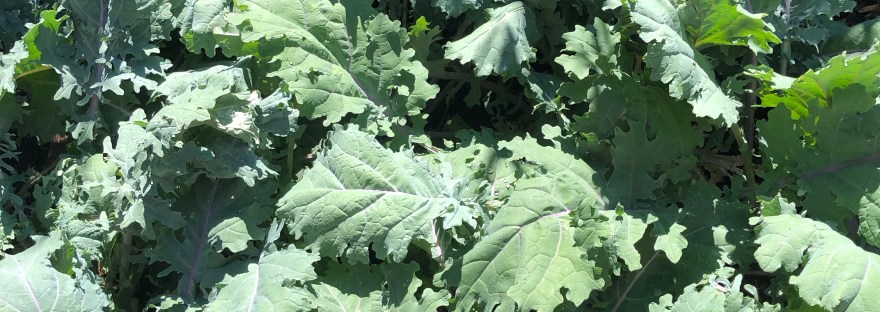
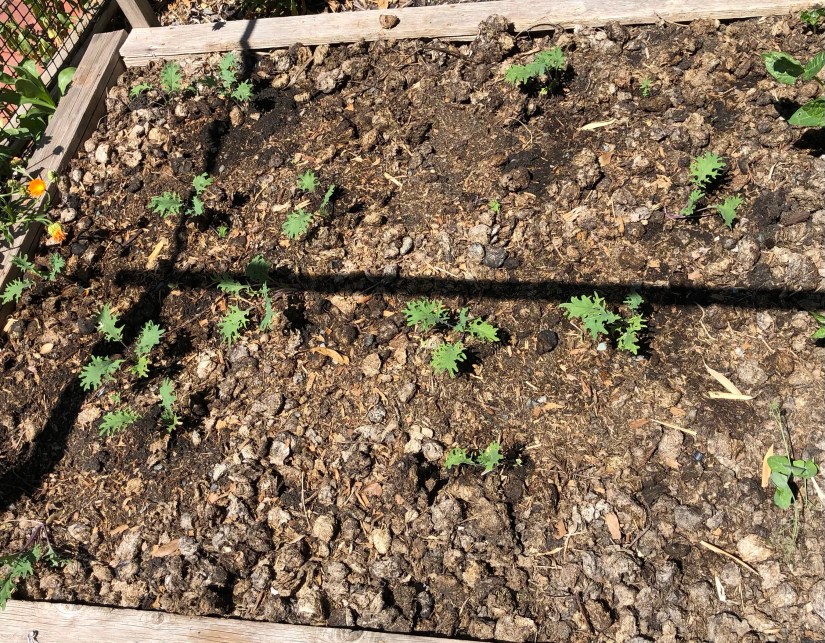
I always enjoy a time-lapse update of things and just in case you do too, here is one of the garden. The first picture was posted in my “That’s Some Big Kale” post. The picture was taken on June 16th.
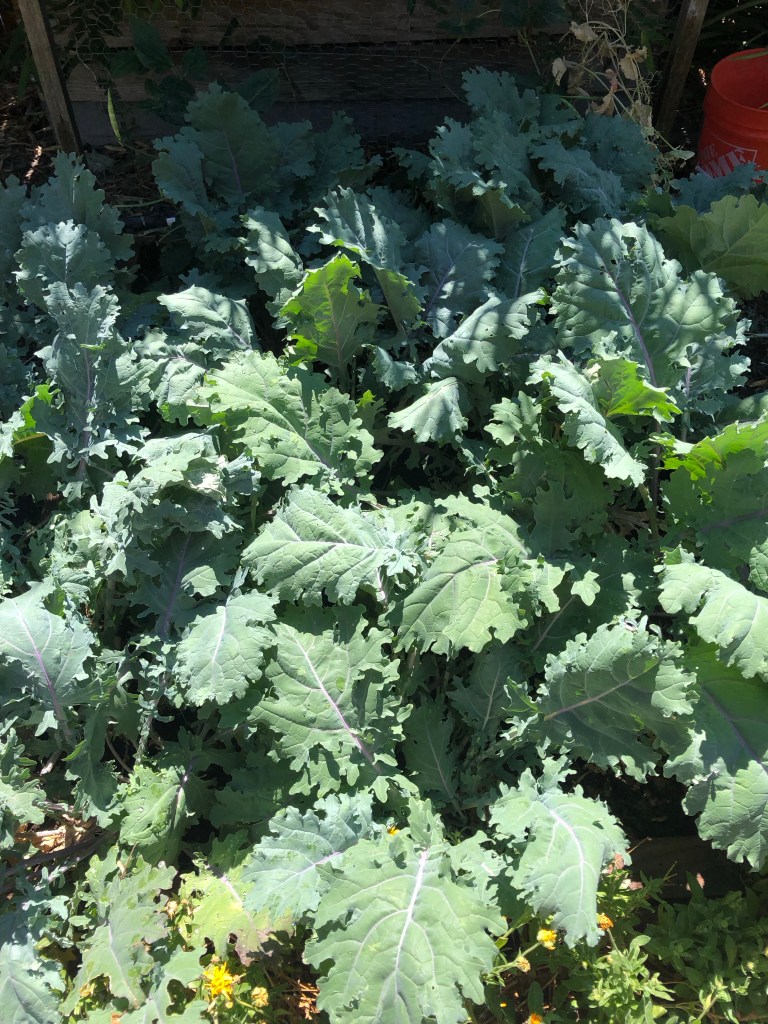
By accident, I took the below updated picture exactly 2 months later on August 16th. It has looked like this for a while now. What a picture of life and vitality. It is such a treat to be able to harvest kale daily for lunch, and we sometimes have it for dinner as well.
I saw someone write on the internet recently saying something like, if you don’t have bugs eating part of your plants, you don’t have a thriving ecosystem. I was reminded of working on the soil earlier in the year. Pre-soil work, there was close to nothing as far as worms or bugs in the earth. Post-soil work, the earth was swimming with life, and I could take handfuls of worms out of the ground and bugs running all over the place. Truthfully, I was a little worried about the young plants getting devoured, but it never happened.
I’m also learning about “no-dig” gardening, which is an interesting concept. You leave the soil intact, as not to disturb the soil biome, and just add nutrients on the top. I tinkered with the concept slightly this year, and I think I will try it fully next year (although, I do love sticking my hands in the earth).
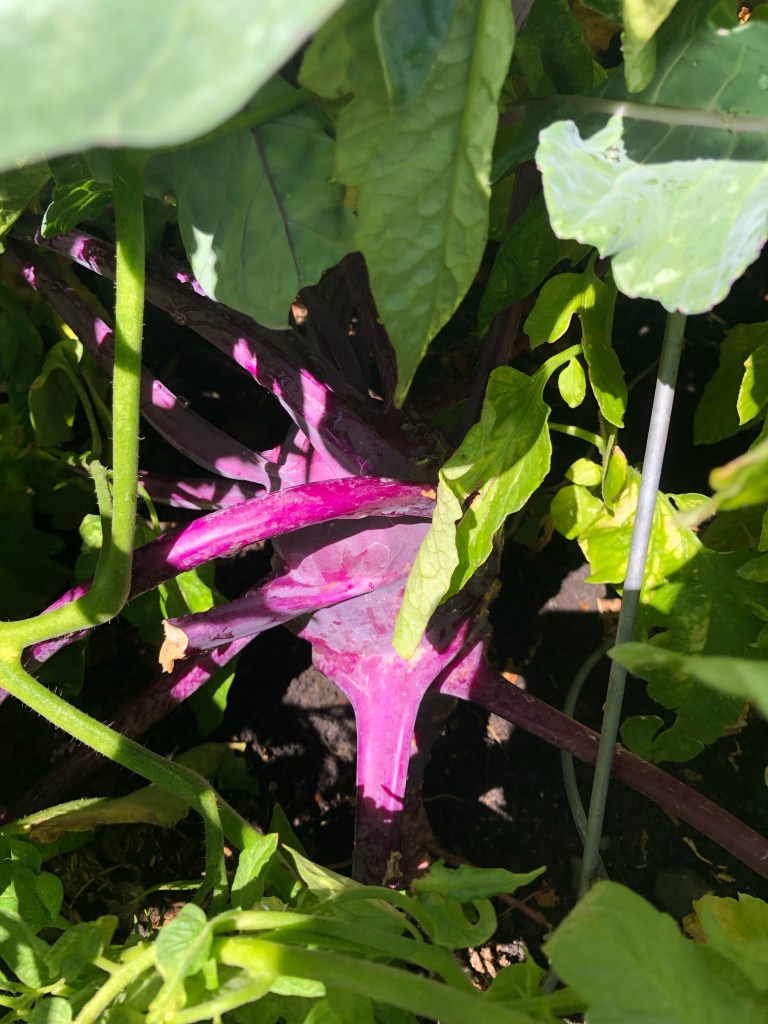
People ask me what I’m growing in the garden. I rattle off my list, and when it comes to saying kohlrabi, people stop me because they don’t have any idea what it is. So here is an updated picture of that as well. It’s ready for harvest (maybe a little late). This one is being engulfed by the tomatoes. It’s from the broccoli family. You can eat the leaves, which taste like taro leaf to me, and the bulb tastes like mild broccoli. I like to add it to my soup, stir-fry is quite good, and we have even cooked it on the BBQ.
Here is my latest set of labs, posted super late. I went on vacation and I didn’t have time to post them before I went. Light chains or M band weren’t run. My doctor’s office really screwed up all my lab orders, from not having them at all or trying to run tests they weren’t supposed to do. They had it set up to run a Hep B test, daily, if I wanted to get stuck every day and not something simple, like a CBC.
Nothing too exciting with my labs. I’m not too thrilled with my Red blood cells, Hematocrit and Hemoglobin. Although, I’m not really that far from the transplant in reality and my blood still gets punched in the face every 2 weeks. Maybe I need to eat more beets and goji berries.
I had my first infusion of maintenance carfilzomib and pills of cytoxan the other day. I had them both prior to my transplant, so my body has prior experience with them (or so I thought), so I didn’t think it was going to be much of a deal. I was a bit tired, so I went to bed a little early that evening.
I got into bed and tried to get comfy. My wife came to bed about an hour later. I was still awake and asked for the thermometer since I was feeling a bit cold. We are going through a heat wave and it was 95 degrees outside, and we don’t have an AC, so it was a little unusual.
98.9 was the reading.
I laid there for a bit longer, pulling up the sheet to my neck. I was starting to shake a bit. I got a fever when I first started carfilzomib and cytoxan months ago, so I guessed I was going through it again since it had been awhile.
99.8 at the next check.
I was really starting to shake, so we added another blanket. Time went by, and I added the comforter. I had all my winter blankets on and it was still quite hot outside. I took a tylenol trying to get my shaking to knock it off, so I could sleep.
102.6 the thermometer read a little while later.
Everyone who has been on chemotherapy knows 101.4 is that magic number when you call the on call nurse and most likely head to the ER. I didn’t want to call, since I had been through this before with these drugs and talked about it with the oncologist last time. I knew they would have dragged me down t the ER to get checked. They (and I as well) are very concerned about infections, but I knew this was just a chemo reaction.
Phase 2 of my reaction was about to begin.
I feel like a lot of people have conversations with themselves when throwing up is involved. Sometimes the buildup lasts for quite a while. “I don’t want to throw up, maybe if I lay this way or that way, I won’t puke.” I didn’t have any buildup or warning.
For a bit of dramatic effect, I’ll narrate the conversation between my body and head.
“Jothi! Get up right now!
“Why?”
“We are going to throw up right now!”
“Really? I don’t really feel nauseous.”
“We are doing this right now! Make a run for it.”
I went to the bathroom and almost immediately threw up. I found it very funny and ironic. I didn’t throw up at all during my transplant or at all during any of my previous times on full strength chemo, and I puked with “maintenance”. Go figure.
I got back into bed and started to shiver again. In hindsight, that probably was not a good omen for my stomach and esophagus. Half an hour later, I asked my wife for a zofran to try and settle things down. Twenty seconds later, my body said:
“Let’s do this again.”
“Are you serious!? We just did that!”
I just got into the bathroom again, and out came the remainder, and it felt like my intestines and liver as well. I got back into bed, with my shakes gone now, and promptly fell asleep for the rest of the night.
My saint of a wife volunteered to dispose of my two rounds of half digested dinner. I only made it to the garbage can both times, so it was very kind of her.
When I woke up in the morning, I didn’t have any fever or vomiting. I spent the day replenishing my fluids.
It’s only been about 4 months since I was on carfilzomib and cytoxan, but I forgot all my do’s and don’ts for those drugs. Maybe I should write a post on it, so I can read it.
But jeez, my torso was sore! I haven’t thrown up at all, probably in nine years. I guess you must have special puking muscles, and mine weren’t at all developed. I wonder if they have a work-out for that?
“For the low low price of $19.99, you can get our puking muscle training program. Strengthen your back muscles, side muscles and abdomen. We guarantee you can puke 5 times in a row without getting sore, or your money back!”
It is test and doctor visit time, post transplant, for me. I had my meeting with my new myeloma specialist today. My old one left to go work for a drug company, so I had to get a new one, which was a bit of a challenge to get, surprisingly.
In my post transplant meetings with Stanford, the doctor kept repeatedly recommending I go on Revlimid for maintenance. In all my meetings with that doctor, I always had the feeling she would rather be off working on her projects, rather than working with patients. “Revlimid is what is normally done post transplant.” Her recommendation of revlimid, showed me she didn’t actually take the time to read my file.
To be fair, she is a transplant doctor and not an oncologist or myeloma doctor, but still, it would have been nice for a little effort on her part.
I finally had to say, “My case is not the typical myeloma case. I’m four years into myeloma and I’m just doing a transplant now. I’m already refractory to revlimid.”
“Oh really!?” She replied, looking flustered, rapidly clicking on her computer, and started trying to recover. “Let me review your case with one of my colleagues and I’ll get back to you.”
I tell you, it’s hard enough dealing with cancer without trying to manage your doctors!
Hence, my reason for paying out of pocket for a myeloma specialist at a different medical institution. I’m really glad I did. This is only my second meeting with a specialist, a year apart, and I can tell their myeloma knowledge is significantly better than my other doctors.
This new specialist told me almost right off the bat, that he is the leader in MRD (minimal residual disease) research. A mrd test is the best test you can have done for blood cancers, looking for remaining cancer cells. I’ve been pestering my regular oncologist for this test and he finally ran it with my last bone marrow sample. I’ve been waiting and waiting for the result, and I guess the specialist had it.
3 myeloma cells in 2,600,000 normal cells. My goal was zero detectable cells (MRD negative or MRD zero), I might as well swing for the fences. Second best is 1 in 1,000,000. I almost hit 1 in a million, just missed the mark. Anyhow, he was quite pleased with the numbers. His goal is to get me to MRD zero.
Although, I was thinking about the MRD test. It is only a sample of the marrow from a specific section of your bone where they pull the marrow from. So you can have different values at different spots in your bones. MRD positive in your left hip, MRD negative in your right. So I guess the MRD result is essentially flawed from the beginning. But I suppose it gives the best idea of what’s generally going on, since blood tests aren’t this sensitive.
I was thinking of the analogy of a city. If I had a city with a population of 2.6 million, and three of those people were crappy people, I would be doing pretty well. My city used to have a lot more crappy people in it, so I’m glad they are gone, but I still have work to do.
My regular oncologist recommended using carfilzomib as maintenance. I was on it prior to transplant, so that makes sense to me. The specialist recommended a higher dose, saying what was recommended wasn’t going to get it done. He also added cytoxan pills, I was also on that prior to transplant, which I’m not too excited about. It’s not an intelligent drug, and it just kills everything. I guess it’s all the lesser of two evils, maintenance versus active myeloma.
I think I’m going to be a bit more beat up from this maintenance than I was originally thinking, which is a bit of a bummer for me. Hopefully we can lessen the drugs over time….