Blog

How To Rub Your Kidneys

This post probably should be called Why Should I Rub My Kidneys? But knowing how to, probably more specifically, where they are to rub, is more important.

Known as “The Root of Life” in Chinese Medicine. They act like batteries for Qi, or energy, for your body. I like to get up in the morning, have a big glass of warm water, and rub my kidneys to charge them up for the day. Your kidneys filter the toxins and waste from your body, and you get rid of that via a direct connection between your kidneys and bladder.

In TCM, the kidneys are also responsible for the production of bone marrow, which governs your bones, brain, spinal cord and obviously your marrow. So anyone with myeloma, blood or bone issues should take extra care of their kidneys. Renal failure or kidney failure is one of the main ways people with myeloma die, getting plugged up with all those extra light chains. These guys are very important to keep running well for everyone, especially people with cancer.

If you don’t believe any of this or none of this makes sense to you, who doesn’t like a good back rub? It just feels good, and you can do it anytime and while doing other things. I rub my kidneys while I cook, because there is a lot of little snippets of time in between things. Rubbing them, while standing and having a chat with a friend is also a good time. If you are too sick to do it, you can get help or get a little electric massager to do the job.

So, where are your kidneys located for a good rub?

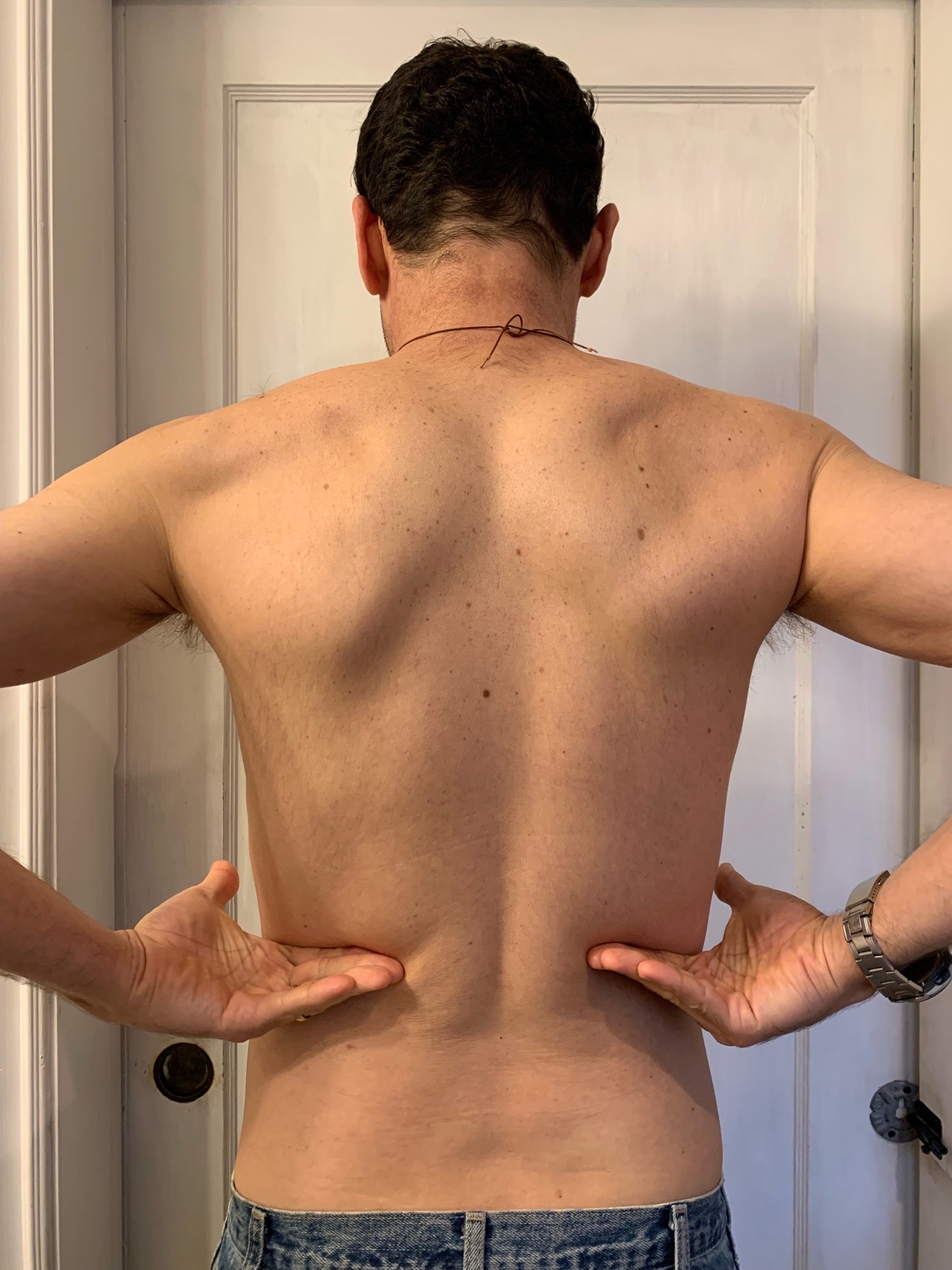
All you have to do is find the bottom of your ribs on your back. Your kidneys are a little under your ribs at the top, and the rest are exposed right under, on either side of your spine.

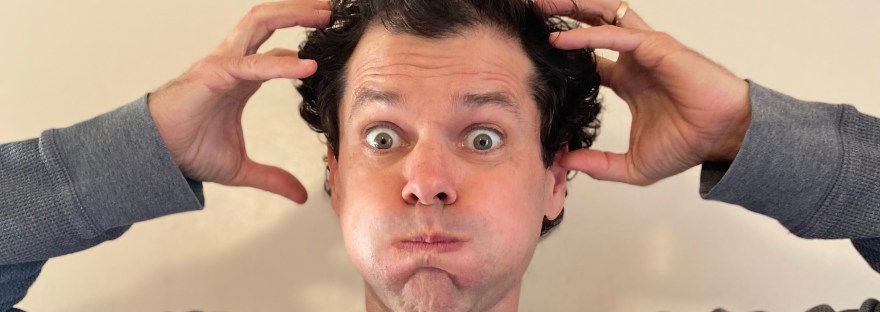
In this picture, my hands are right up against the bottom of my ribs, so that’s the level for my kidney massage.
There are also two thin tubes of called ureters that run between your kidneys and bladder. I also like to rub from my waist to my kidneys to get those a bit of a massage as well.

The actual kidney massage should be whatever feels good for you and your body type. You can go clockwise, counterclockwise, back and forth, and up and down.

Using a closed fist versus open hands will change the feeling as well.

In this video, I’m using the Qi Gong method of massage, using the acupuncture point, Large Intestine 4, or the Great Eliminator, on my kidneys. If you make a V with your pointer finger and thumb, the spot is at the bottom of the V. (LI-4 is also a good spot to rub in general or if you are going through some constipation)

I do find it interesting, as I’m currently going through carfilzomib. I can feel my kidneys working hard a few hours after the infusion, especially when my urine turns a putrid color. I can feel that my left kidney is having a harder time with things than my right. I make sure to drink lots of fluids and rub, rub, rub especially on the left.

It’s a minimal commitment to do and another simple tool to put into your well-being toolbox. Give it a try!
Nutrition

Mighty Mung Beans

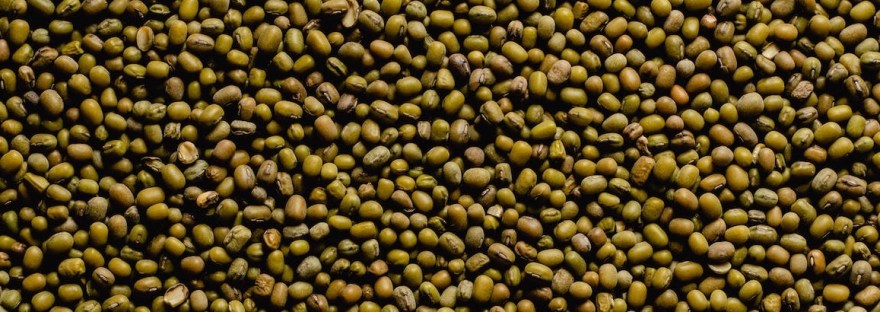
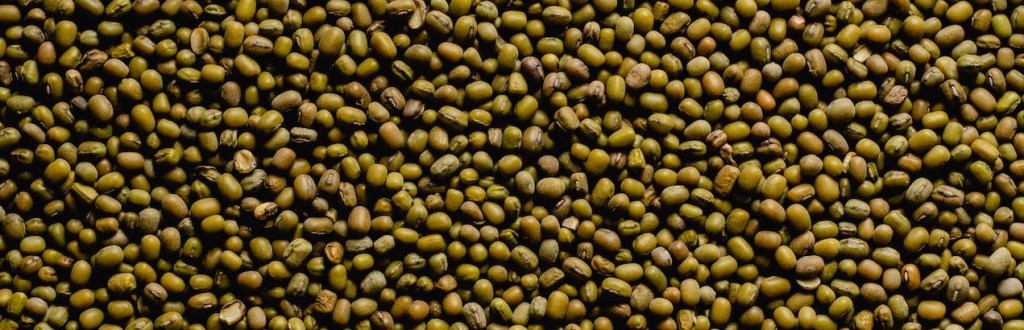
Mung beans oh mung beans. I love mung beans so much, that’s the title of the song I made up for them that I sing when I cook them (mainly to make my children roll their eyes).

This legume is a powerhouse that is a staple in Asia, and it definitely doesn’t get its recognition here in the West. To put it into perspective, I almost feel like it’s the corn or wheat of Asia, except it’s so much better for you.

You can make soups, deserts, noodles, snacks, and of course, bean sprouts, which is probably how most westerners eat them, maybe without knowing what they are.

Human cultivation of mung beans started about 4500 years ago in India. It is easy to cook, easily digestible and nutrient dense. All those traits are super important for all people and extremely important for people who are going through cancer.

In both Ayurvedic and Chinese medicine, mung beans are very cleansing and rejuvenating for the body and its organs. Who wouldn’t want that? They have been a constant companion on my health and cancer journey. I eat 1/2 of a cup of them every day.

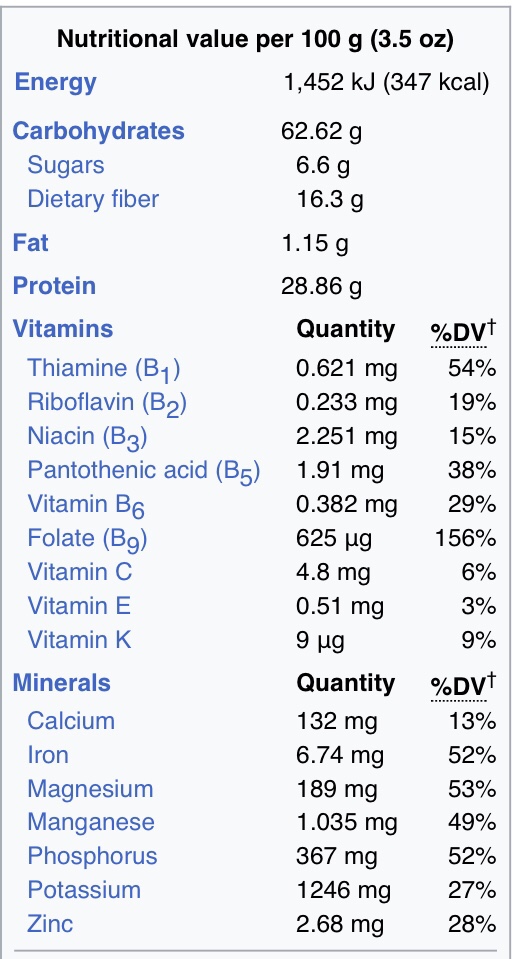
This nutritional chart is for 3.5 ounces. 3.5 ounces is about half a cup. Talk about a nutritional powerhouse wrapped up in this tiny little legume. Protein, vitamins and minerals. It’s pretty ridiculous how good these are for you.

Just to remind you, 50 grams of protein is the recommended daily amount for an adult, and you can get more than half of that from less than half a cup.

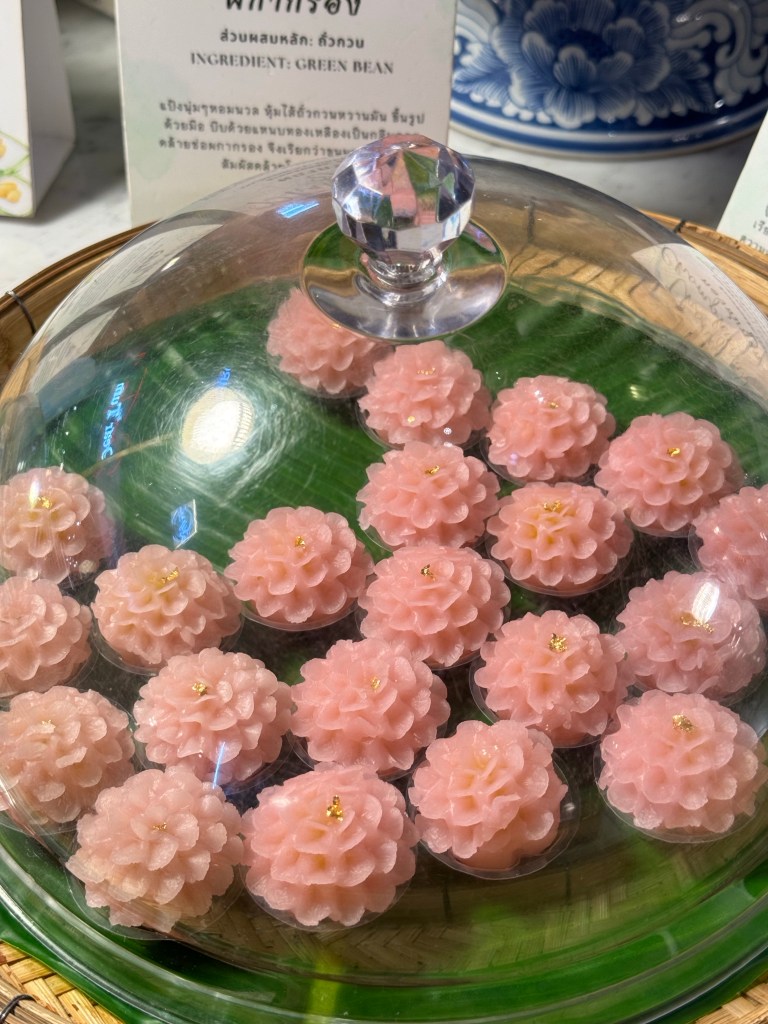
My brother recently went to Thailand and sent me this picture because I’m such a mung bean fan. It is a desert made from mung beans. They look pretty awesome and quite different from a small green bean. Their use is only limited to a person’s imagination.

Here is my simple mung soup recipe (I do have a deluxe version as well).

  • Soak overnight 1/2 a cup of mung beans
  • Rinse well when ready to cook.
  • Add the mung beans to a pot with 2 cups of water.
  • Add a pinch of Asafoetida
  • Add a pinch of ground black pepper
  • Add 1/2 a teaspoon of each of cumin powder, coriander powder and turmeric powder (turmeric is anti-cancer, especially myeloma).
  • Chop and add half of a small onion
  • Grate and add one knuckle of ginger (two inches)
  • Stir in a teaspoon of coconut oil
  • Bring to a boil. Mung beans will be cooked when the beans start cracking open and are soft.
  • Add salt to taste

It’s pretty easy to make. I encourage you to try to incorporate these little wonders into your diet, and maybe they will do something wonderful for you.

Blog

How To Stop Unstoppable Hiccups

As it turns out, one of the rare side effects of dexamethasone is uncontrolled hiccups. And guess what? I am lucky enough to have that side effect.

It was kind of funny the first time it happened, years ago now. Hic hic hic. I tried all my normal methods of stopping hiccups. Held my breath. Drank some water. Held my breath and drank some water, etc. Nothing worked. Hic hic hic. I thought they would just go away with some time. They didn’t.

I was hiccuping for hours and things were starting to get hairy. I was hiccuping up stomach acid, and it was getting painful, and I couldn’t get it to stop!

It turns out there is a simple solution for any hiccups, unstoppable or regular. Also, the great thing about it, it stops them very quickly.

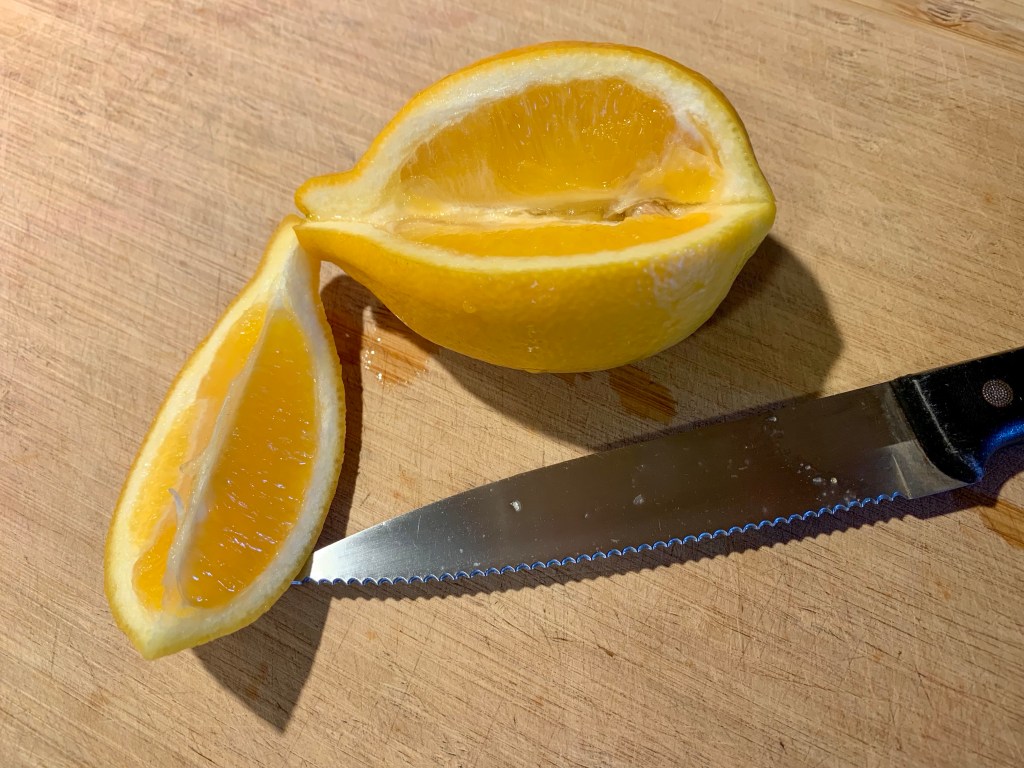
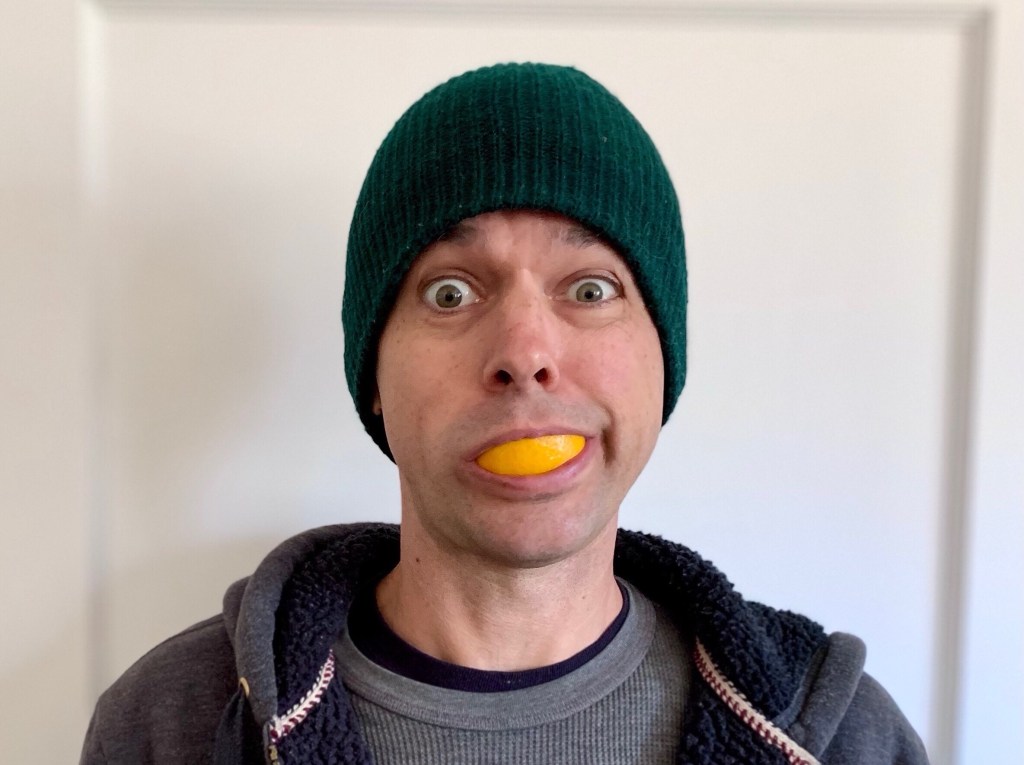
Sucking on a lemon wedge. Something about the sour and the sucking motion, wipes out hiccups almost instantaneously. Plus, who doesn’t look great with a lemon wedge there instead of teeth, added bonus!

All you have to do is bite a little bit on the lemon flesh, to release the juice, and suck on the wedge like a pacifier. Make sure you are swallowing the juice as you do it. I was a little concerned when I was hiccuping up acid, adding more acid (lemon juice) to acid, but it stopped them so quickly, I almost felt like my esophagus’s life had just been saved.

Now if they ever start, I get a lemon wedge right away and not let it get that far. There you go. I hope this saves your esophagus’s life or at least some sanity from not hiccuping forever….

I had to add this one, it was too funny. I think I would make a good passport photo, imagine the immigration officer’s face.
Blog, How To

How To Stop Freaking Out Or De-Stress

By Breathing of course.

Have you ever given awareness or paid attention to your breathing? Sometimes when I’m watching TV in the evening, I’ll randomly do a check in, to see how my breathing is going. Sometimes, I’m surprised to find that I’m breathing rather shallow. Especially, I notice it when I’m watching sports and I want my team to win. I’m stressing out over something silly, like a sports game, that actually doesn’t matter at all.

Working, driving, family, friends, money, pets, a chronic condition, waiting on test results, any number of things or life in general, can be stressful!

I’ll let you in on a secret of mine.

I’m afraid of needles, especially blood tests. I laugh at the irony of it all the time. Go figure, I would get a blood cancer.

For months, in the last number of years, I have had to go in for weekly blood tests. I could feel myself wind up as the days went by, to see the vampires, got closer and closer. Feeling that heavy pit in my stomach. Sitting there, in the chair, as they put that rubber band on your arm. Waiting as they are about to stick in the needle. Darn! They missed the vein, now they have to dig around for it or stick me again (I actually have easy veins too). Sometimes, I break out in a sweat, heart pounding. Shaking, when it’s all over.

Well, that doesn’t sound like a good state to be in.

I was just put into fight or flight mode, and I need to be in rest and repair mode as much as possible. A person doesn’t think clearly when they are in fight or flight state.

Breathing is the best way to get back into rest and repair mode and stop stressing or freaking out. It doesn’t matter the reason you are freaking out for these techniques to work. Sometimes just giving awareness to your breathing can be helpful. Just recognize and correct the situation.

I would like to give credit first, mainly because I don’t think it’s said enough, to India, to yoga, to preparing to meditate and meditation. Not to our western version of yoga, the real deal thing developed in India, where these breathing techniques come from. I will always be grateful for the life altering practices that I learned there.

Technique 1:

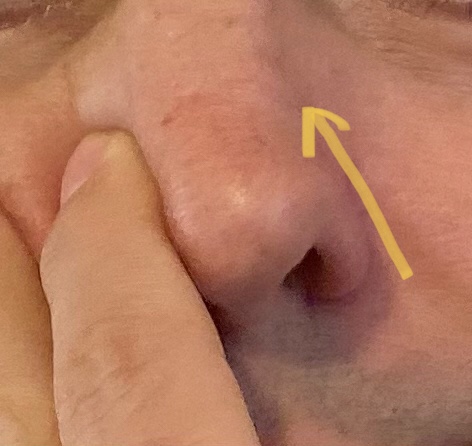
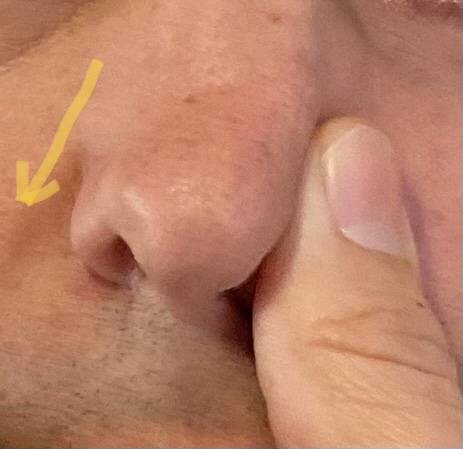
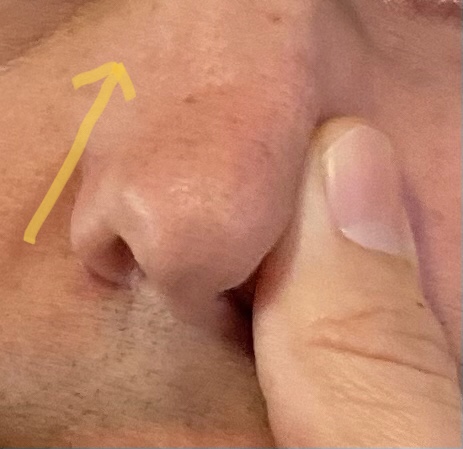
Alternative Nostril Breathing. This is my personal go to. I do it when I feel stressed and need to calm down and reset.

Begin by holding your right nostril closed and breathe in through your left.

Next, close your left nostril and breathe out through your right nostril.

Keep holding your left nostril closed and breathe in through your right nostril.

Then close your right nostril and breathe out through your left.

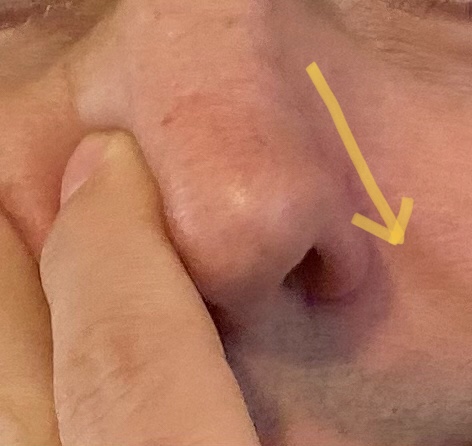
This completes one set. Try and count to yourself the same number of counts breathing in and keep it the same number breathing out. Whatever number is comfortable for you. (I’m pretty sure I missed my calling as a nose model, what do you think? 🤪)

I also do a version of this, for at least 10 minutes, every night before I go to sleep. This version must be done when you are calm and not stressed. It’s the same except, you hold your breath for a count of 1 after you inhale both times.

Technique 2:

Sigh Breathing. I really like this one too. I do enjoy a good sigh.

  • Sit up straight.
  • Take a deep, slow breath in through your nose, filling your lungs to full capacity.
  • Hold your breath for 3-5 seconds.
  • Release your breath through your mouth with a sigh (or a good groan 😜).
  • Repeat until you feel better.

Technique 3:

4-7-8 Breathing. This one is amazingly good and quick for snapping you back into instant clarity. I think maybe it has to do with the lack of oxygen coming in at times. Again, alternative nostril breathing is my number one choice, but this one is really helpful in certain situations.

  • Start by exhaling completely.
  • Breathe in for a count of 4.
  • Then hold your breath for a count of 7.
  • Exhale for a count of 8.
  • Repeat. I find that it usually only takes 5 times or so to be re-centered.

A quick note on counting. Make sure you are counting the same way, with the same timing. I can count to 8 in the same time as 4, but that defeats the purpose of doing these breathing exercises. 8 should be twice as long as 4!

Technique 4:

Square Breathing. I don’t use this one much, but I know people who really like it.

  • For this one, the number count doesn’t matter, do what works for you, but the number has to remain the same (i.e. a count of 4 or 5).
  • Start by exhaling completely.
  • Breathe in through your nose for the count of 4.
  • Hold for the count of 4.
  • Exhale through your mouth for the count of 4.
  • Hold again for the count of 4.
  • Repeat.

Technique 5:

Straw Breathing. This is a fantastic one for kids.

  • Breathe a full breath in through your nose.
  • Puff up your cheeks with air and blow out slowly through your mouth like you had a straw in your mouth.
  • Repeat.

For me personally, I can get through my bloods tests and IV’s fine now (and most other things), without freaking out. I’m still very much a work in progress.

I was trying to think of a number 2 for de-stressing besides breathing. Breathing is number one on my list because it’s so effective, it doesn’t cost you anything, and you can do it anytime and anywhere. I would say that exercise would be number 2. But it’s funny though, if you’re exercising, give awareness to your breath, and you’ll notice you breathe very deeply and rhythmically, usually the same count in as out. So in the end, is it breathing again?

Breathing is so amazingly simple and it is so amazingly effective. This should give you a number of tools to help you get through life or de-stress. I hope you find one that you like.

Breathing will help you regain yourself when you lose yourself. But if you want to keep a level head and not lose yourself to begin with, meditate daily, but that’s a whole other topic…

Kabaam!
Blog, How To

Tips For Radiation Therapy

(And I suppose they mostly work for chemotherapy and life in general.)

It’s one of my goals to write more practical every day posts and I have a bunch of them in my head. Here is the start of hopefully a good long line of helpful things for people going through it.

I had 10 days of radiation treatment to my pelvis and sacrum area, years ago. There are drug options for side effects, but I always prefer to do it naturally as much as possible, since they generally don’t have additional negative side effects. Here are some (hopefully) helpful tips.

Constipation:

When I think of unusual constipation, the first thing I think of is psyllium husks. Nothing but 100% pure fiber. (I use Anthony’s organic psyllium husk, from Amazon) Mix 1-2 tablespoons with a full glass of warm water, stir and drink it down. Usually within a few hours, your symptom will be relieved. You can use a tablespoon of psyllium husks with a glass of water daily if you know you’re going to be challenged.

You can combat normal constipation by just drinking enough fluids a day. I personally start my day by drinking 24oz of water and rub my kidneys. I’m always shocked to hear how little some people drink through the day. Your pee color will tell you if you are drinking enough. If it’s not light yellow or clear, DRINK MORE!

Diarrhea:

Try the BRAT diet, which stands for bananas, rice, apple and toast. I definitely had some bowls of brown rice and bananas when my intestines were getting hit by radiation on the way to my bones. Coconut oil or shredded coconut can also help take care of diarrhea.

Coconut oil or ghee topically can help tremendously with a sore butt from all the trips to the bathroom.

Dehydration:

The World Health Organization fluid replacement electrolyte solution is 1/2 tsp of salt, 3/4 tsp baking soda, a cup of fruit juice, mixed with 1 liter of water.

Obviously water is also important to drink and mineral water is also helpful (especially if your stomach is queasy).

Dehydration will happen from either the diarrhea or vomiting. Make sure to stay on top of your hydration! Try to drink a 8oz cup, per trip to the bathroom (diarrhea). Don’t start replenishing fluids from throwing up until you can keep them down.

Fatigue:

Exercise exercise exercise. It’s hard to get up and move your body sometimes, but it does help out tremendously. Keep in mind that you are going through a lot and not to push too hard or too fast. Just walking every day can be helpful. Give yourself permission to rest and get some help when you need it.

Dry skin/burns:

I’ll start with, Do Not put oil or lotion on your skin in areas that are actively being radiated! What until your treatment is complete. Oil with radiation will cook your skin and burn you, Kentucky fried human.

Make sure to be your own advocate for shielding your other body parts that don’t need to be radiated. It doesn’t hurt to make sure you get the best care/protection possible.

I used coconut oil and Vitamin E on my skin. You can just get Vitamin E capsules and break them open. Vitamin A cream is also supposed to be very helpful (I haven’t tried it though). It definitely took awhile for my skin to recover fully. Keep at it.

Blood counts:

As you know by now, I’m huge on nutritional diet. Vegetables can have an amazing effect on the quality of building blocks your body uses. Fresh vegetable juice gives you a large quantity of vegetables in a less filling application. Juice carrot, beet, green apple, ginger, turmeric, greens, celery, pomegranate and sprouts. Any combination works. Vegetable juice can also rejuvenate and cleanse your organs and combat constipation. Feed your blood!

Nausea:

I use ginger for this. I cook with it, I make tea with it. I put it in my vegetable juice. It works super well for me. Try have some ginger tea. Take 1/2-1 tsp of ginger powder and boiling water and pour it into a cup. Stir it a little while you wait for it to cool and that’s it. You can also take fresh ginger, cut it up into pieces and put it into a pot and bring to a boil. Either work. Try it.

Eating bland food or dry food can also be helpful. Not all nausea is the same, sometimes you just have to experiment with it.

Other things:

It is said outside of conventional medicine that a low glycemic diet while undergoing radiation therapy can make a huge difference in effectiveness. If you’re going to do it, you might as well try and make it as effective as possible. Sugar increases growth factor IGF-1, which suppresses cancer cell death. You have nothing to lose and everything to gain by trying it, why wouldn’t you?

Again outside of conventional medicine, Ashwagandha. Ashwagandha is said to make cancer cells more sensitive to radiation and protect healthy cells. You do have to take ashwagandha with at least 5% withanolides. There is a lot of ashwagandha out there, withanolides are the active compounds of ashwagandha. It’s not worth taking without the 5%. I did not use it while I did radiation, only because I didn’t know about it. Ask your doctor and make your own decision. I have taken lots of ashwagandha at different times in the past years. It does help calm and can help you sleep. It had no negative effect on the chemo I was taking.

Best of Luck!

Blog, How To

My Power Breakfast Recipe

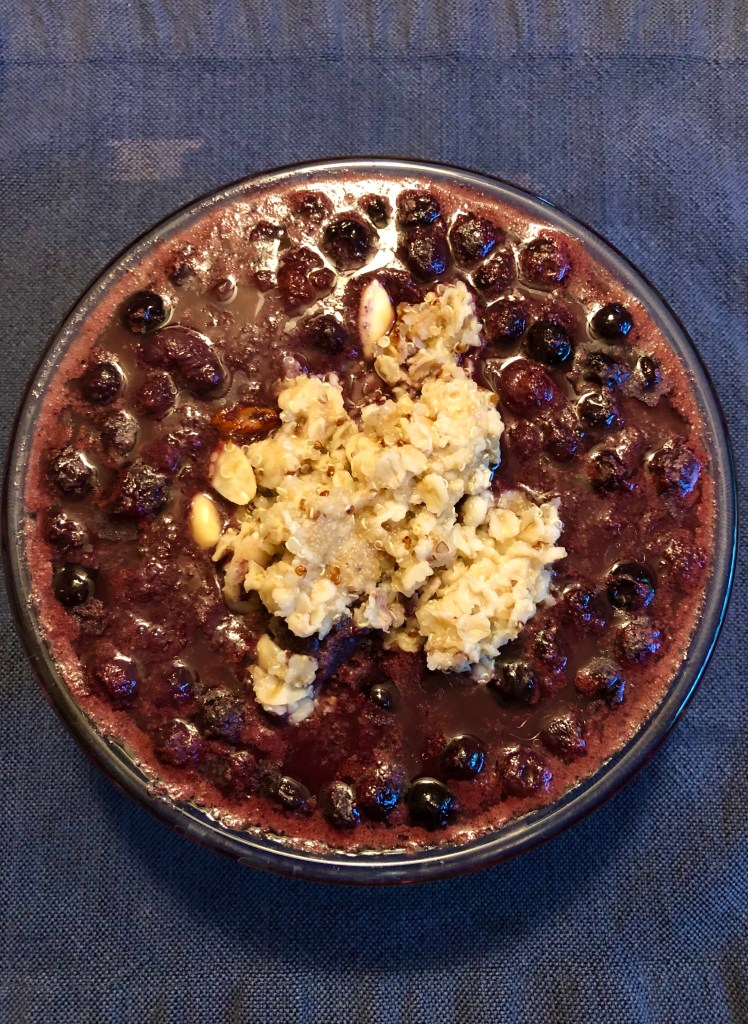
I touched on my breakfast recipe in my post My Diet – Part Two. Here is the whole thing. I have additional information at the bottom. Please read the notes.

Ingredients – one serving

  • 1/2 Cup of Rolled Oats
  • 1 Tablespoon of Quinoa
  • 1 Tablespoon of Amaranth
  • 1 1/2 Half Cups of Frozen mixed berries
  • 1 Tablespoon of Goji berries
  • 1 Pinch of Clove Powder
  • 1 Pinch of Cardamom Powder
  • 1 Tsp of Cinnamon Powder
  • 1 Tsp of Ginger Powder
  • 1 1/2 Tablespoon of Coconut Oil
  • 10 Soaked Overnight Almonds
  • 1 Tablespoon of Chia Seeds
  • 5 Tablespoons of Flax Seeds
  • 3 1/3 Cups of Water

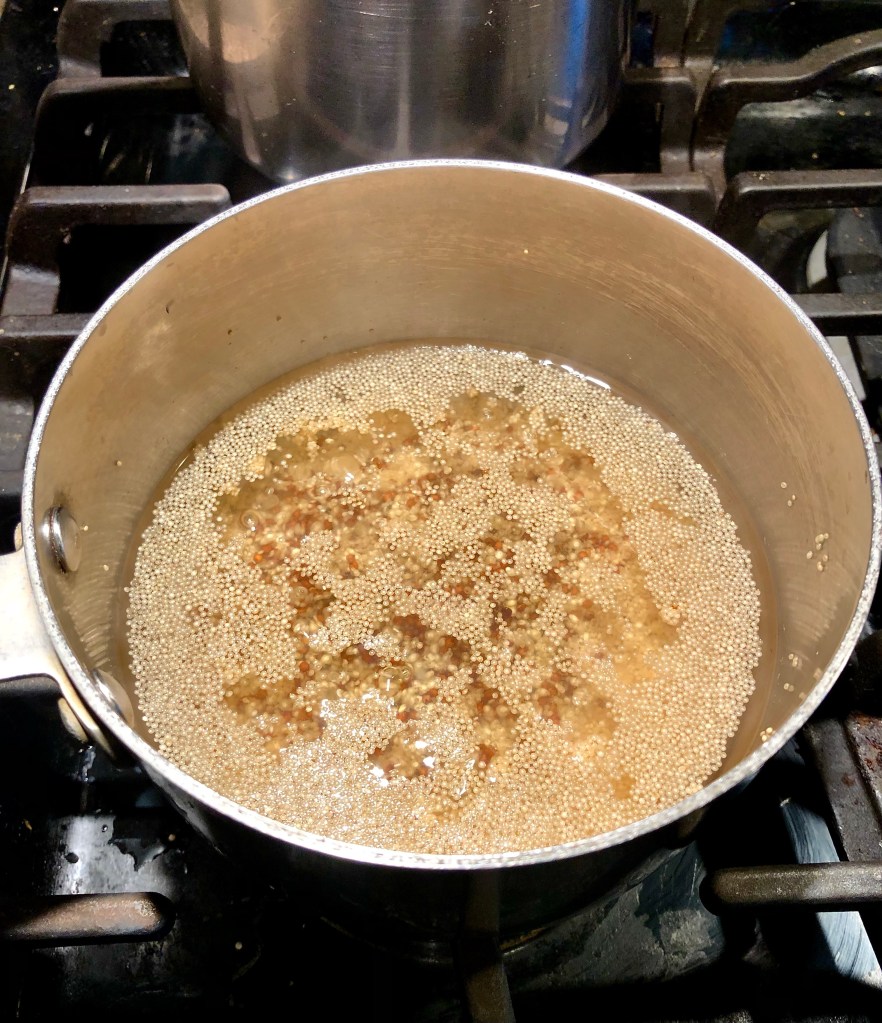
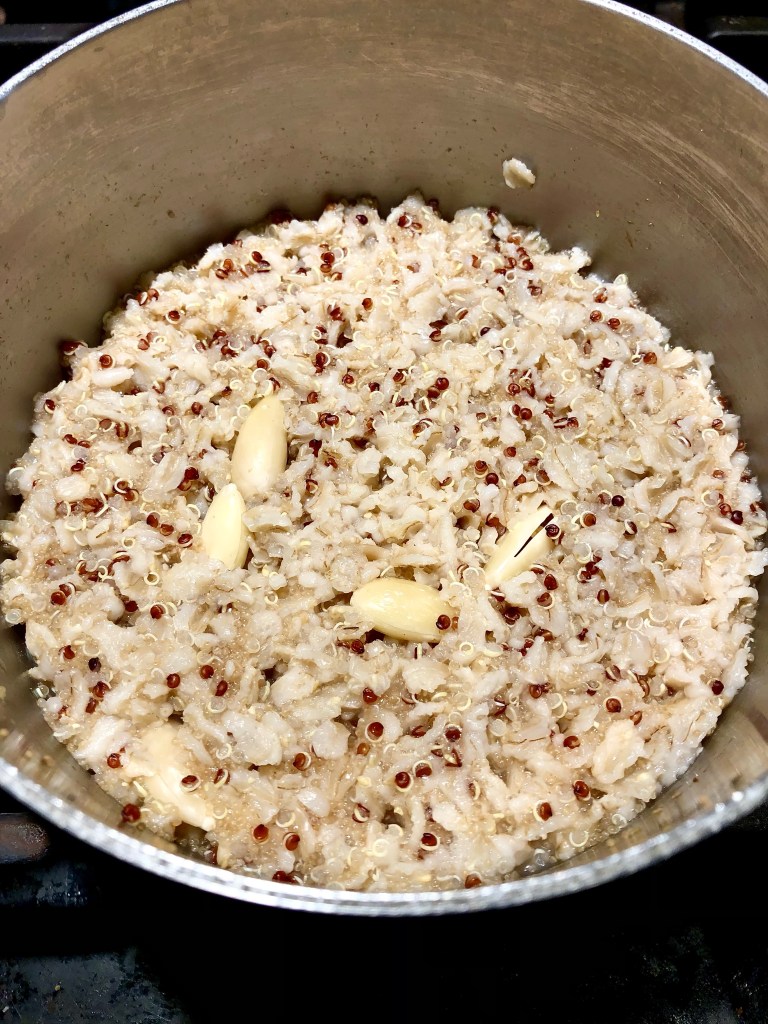
Boil 1 1/3 cups of water in a small pot. Once boiled, add the Quinoa and Amaranth. Turn the heat to low. When the Amaranth gets shiny or drops to the bottom of the pot (about 5 minutes), add the rolled oats. Remove the almond skins, add to pot and stir. Cooked when water is gone.

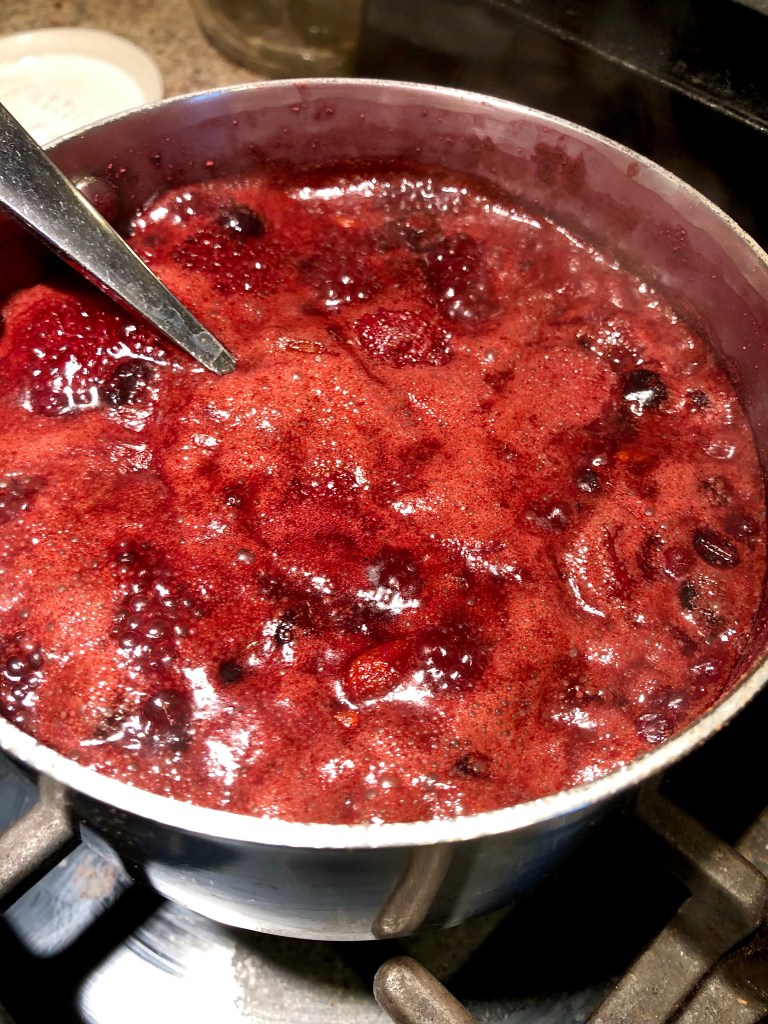
In a separate pot, add the goji berries, mixed berries, spices and remaining 2 cups of water. Stir the mixture every couple of minutes to have the spices well mixed and cook (enhances flavor). Bring to a boil. Turn off when goji berries look fluffy and blueberries start to lose color.

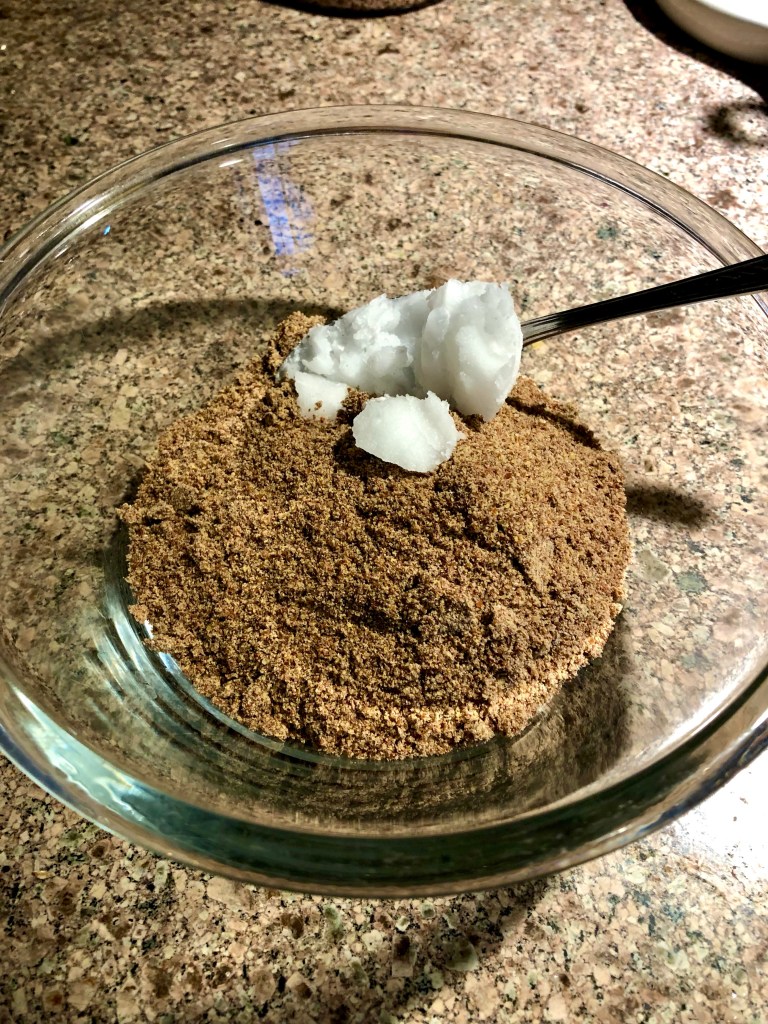
Add the chia and flax seeds to a coffee grinder and grind for about 15 seconds until you have a smooth powder. Dump the powder into a large eating bowl. Add the coconut oil.

Add the berry mixture into the bowl with the flax mixture. Mix together and let it sit for 2 minutes to let the chia and flax absorb some of the berry mixture water.

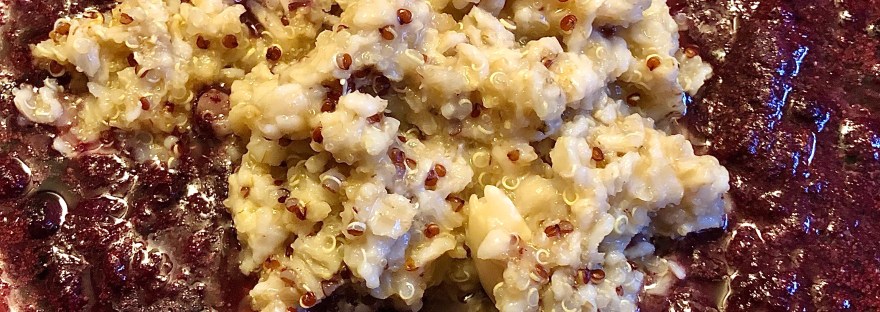
Lastly, add the cooked oatmeal mixture. Breakfast is served!

A couple of notes.

I use frozen berries because they are less expensive than fresh ones. Either is good. Mixed berries sometimes have a lot of strawberries in them, which I try and keep to a minimum (trying to keep my body balanced, low on acid foods, it’s an Ayurvedic/Chinese medicine thing).

Sometimes, I add or just use mini wild blueberries (from Canada, usually). They are slightly different in nutrition. I’ve heard they also remove things like radiation. I especially like to have them after getting scanned.

As you saw, I add coconut oil to my breakfast. It is a healthy fat, antibacterial, antimicrobial. Everyone needs healthy fats to their diet. This is one place where I get part of mine, which is the reason it’s in there. If you don’t need it or want it, don’t add it. Don’t substitute poor quality other oils.

Flax! I have a lot of it here in my breakfast, as you can see. It’s really amazing stuff. It is so good for you on so many different levels. That being said, there are cases where this level of flax is too much. For instance, people who have breast cancer. One tablespoon max of freshly ground flax can stabilize and bind excess estrogen, beyond that, it can potentially cause undesirable consequences. Please get educated about your condition or ask your doctor. If in doubt, just use a tablespoon or two.

I don’t use sweetener of any kind. I do believe that added sugar fuels cancer growth, among other things. My taste buds have adapted to a very low sugar diet (which is quite amazing, but that’s a whole other story). If you need some sweetener, try add some raisins.

If you are having trouble with your appetite, try and add more water. I find that watery food is easier to intake than thicker food.

I hope you give it a try and like it. If you want, leave a comment about any tweaks in the recipe you enjoy 😊.